Showing posts with label Vocaloid. Show all posts

Producer Spotlight: myGOD-P

On Tuesday, May 21, 2013 1 comments


It’s time to shine the spotlight on another ace Vocaloid producer! This time it the multitalented myGOD-P. Yes, that is his name. Before he settled on that bold moniker, he went by the handle G9fried@GRM. As you might be able to guess from his names, his music is eccentric. It leans towards techno/rock, but he’s covered genres as varied as opera and ballads. His works are weird and wonderful, and every Vocaloid fan should listen to a few. So pop in your earbuds and let’s take a listen to a sampling of myGOD-P’s works.

Looking normal enough so far! 
One of his earliest songs is titled “BAND of CATS.” It’s jazz influenced, with some nice piano work in the background. While the song itself is kind of bland, it’s worth listening to in order to see just how varied myGOD-P can be. This work shows him beginning to experiment with genres, adding overtones of ballad music and melancholy vocals to a swinging jazz number.

“Exclamation of my heart” is another early song, and it still shows the developing stages of myGOD-P’s over-the-top style. However, it is very catchy. Pay attention to the echoey vocals. This is prominent in his later works. Once again, this song comes across as an experiment, more playing with the technology and seeing what it can do. It is still a highly interesting listen.
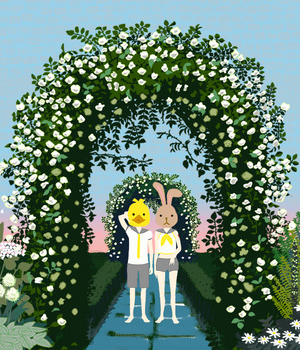
...aaaaand normality is gone.

If you want versatility, check out his Kagamine opera, titled “Garasu no Kutsu.” This piece shows that he is a master of the slow and sorrowful as well as the frenetically upbeat. Seriously one of the most moving Kagamine pieces, it is filled with orchestral swells and vocals that speak of hope and longing. There aren’t very many Vocaloid songs out there like this.


Skip ahead to his song “Virgin Glory,” featuring Hatsune Miku. This song is weird as all get-out, with a funky, screechy guitar line and a pulsating beat. It has simplistic yet nonsensical lyrics. The whole thing feels off-kilter, like a normal techno song turned on its side. What is also significant about this work is the MMD accompanying it. It’s very simplistic, but the sheer absurdity of it would also become a hallmark for myGOD-P’s videos.


If you thought the last song was strange, get a load of “Battle in TAKAMAGAHARA.” Once again, it’s a techno/rock song that is just a little out of the ordinary. The lyrics alternate between lofty and beautiful to hoarse and grunting. There’s a lot going on at once, like the song is trying to see just how over-the-top it can make itself. That is classic myGOD-P. Once again, it has a MMD accompanying the song that is just…baffling. Check out MEIKO and KAITO rocking those guitars. Yeah baby.


And the awesome just continues to escalate with “HYPER TIME!” This work bears the traditional repetition of techno buzzes and beeps with the complex guitar solos of rock and roll. The vocals are heavily distorted, to the point where he lists Yowane Haku as the singer instead of Miku. MyGOD-P loves messing with the vocals, turning them inside out until they no longer sound like a human singing. The result is slightly unsettling but totally cool. Did I mention that deino made the character models? If you don’t know who deino is, you haven’t been to the dark side of Vocaloid. 


“take the field (FULLMOON)” is one of my favorite Vocaloid songs. It even has the underused LOLA adding backup, along with a sexily distorted KAITO. The guitar is rocking, the beat is strong, it’s really something you can bang your head to. At the same time, the scratchy singing and unusual choice of background harmony make the whole song feel like some otherwordly rock concert. The music video gives the same effect. It’s simple, yet weird. It really feels like you tuned into the MTV of another world (provided their MTV actually plays music, unlike ours). The frantic pace of the song makes it feel like it ends all too soon, but that’s what replay buttons are for.


Returning to his Kagamine roots, “I WANNA TRUST YOU” is an upbeat duet between the twins. Compare this to his earlier works and you can see how distinctive his style has become. There’s his signature blend of techno/rock, but with a brass accompaniment that speaks of jazz. Once again, myGOD-P isn’t afraid to blend genres as it pleases him. The vocals are deeply satisfying, with an alternating between a deep, confident Len and a high, energetic Rin.


“Posterization” is another song that seems to be commenting on the media saturation in society. It’s bizarre enough that I can’t be sure. The MMD is minimal but effective. MyGOD-P uses repetitive lyrics that slowly build to an explosive finale of noise.


Finally, no survey of myGOD-P would be complete without mentioning his Girl and Boy series. This is a sequence of songs that tells the story of an ill-fated couple. It was actually based around a doujinshi story, and then myGOD-P made songs out of it and got artists to illustrate it. His most recent work is a medley of the songs that includes a PV. Unlike his techno-explosions, this series represents his softer, more heartfelt side. The songs still show traces of his style, with the guitar backgrounds and occasionally distorted vocals, but for the most part they sound more “normal.” This doesn’t mean they are bland. Instead, they are just story-focused, more reliant on the message of the lyrics. This series is a must listen if you love narrative songs.


So there we go: my GOD-P in a nutshell. Of course, he is an extremely prolific artist (up until about a year ago). He has a huge catalogueof songs to look through. So if you liked the stuff you saw in this spotlight, go check out his other work!

Do you have a Vocaloid artist you want spotlighted? Let me know in the comments below, or shoot me a message.



Read more ...»

Producer Spotlight: Iwashi-P

On Monday, January 28, 2013 1 comments


Welcome to producer spotlight! Here I’m going to highlight talented Vocaloid producers and their works. This week’s producer: Iwashi-P.

Iwashi is a fairly obscure producer, with only a few of his videos getting more than 10,000 hits. That’s a darn shame, because he (or she?) is an absolute god with KAITO. One of the best things about him is that he has a distinct, signature style to his tuning. In his hands, the normally shrill KAITO sounds husky and deep. Probably some mixture of gender factor and low clarity.

Kaito Vocaloid Wallpaper - vocaloids Wallpaper
Don't think KAITO can be hardcore? Just wait.

His songs have a dark, mournful feel. They are very atmospheric, with lots of pulsing rhythms. Not quite techno, not quite rock, but a sort of earthy-pop. KAITO appears to be the only Vocaloid he works with, but don’t let that turn you off if you don’t like the blue boy. Let’s take a closer look at some of his works.

His very first song was called “receive,” released back in 2008. I couldn’t find any uploads of it on Youtube, so if you want to check it out you’ll have to use niconico. Anyways, this is definitely an amateur work, more of a test run than anything. However, you can tell that the composer has talent. It sounds distinct and cohesive, albeit with only traces of the elements that would later define Iwashi. http://www.nicovideo.jp/watch/sm3222294

Iwashi also draws the cover images for his songs.

Things improved immensely with “crow.” Once again, it’s not on Youtube. This song finds a nice balance between sounding like a dirge and a war chant. It’s face-paced without being sugary.

“Oni to Musume” (or ogre and the maiden) is probably his most popular work. It’s based on a Japanese folk-tale about a blind girl falling in love with a monster. The sounds fits very well, with a rustic, old-school Japan feel. There are a lot of traditional instruments, and the overall feel is that of a ballad. The mixing isn’t the greatest, but it is a beautiful song. And it comes with a cute PV!


From this point on, his songs are all awesome. My personal favorite is “Scissors.” I only understand a few words, but I would guess it’s some sort of bitter break-up song/ yandere thing. What’s great about it is that it sounds more angry than whiny. It’s filled with longing and resentment. And a pretty sick beat.


His latest song to date is “free word mind game.” It’s much more “pop” than a lot of his works, with a very bouncy, upbeat rhythm. However, the chorus has that cyber-punk element that makes Iwashi unique. Definitely worth a listen.


Iwashi only comes out with a couple songs a year. However, every one of his songs is a treat. He’s talented, and he deserves more views than he gets. So if you like KAITO or electronic music, check out his stuff. You won’t be disappointed. 

Do you have a producer you want spotlighted? Feel free to leave me a suggestion in the comments!
Read more ...»

In defense of Vocaloids Part 5: Niche Music

On Tuesday, December 13, 2011 1 comments

I don’t like pop music. I think that’s pretty well established at this point. However, pop music has one thing going for it: you can dance to it with your friends. In the words of the Nostalgia Chick, “Pop music is the lowest common denominator.” It’s designed to have a very broad appeal, to use whatever passing trends are popular. Maybe Vocaloid songs will one day have that kind of reach. I don’t know, and I’m not going to make unsubstantiated predictions. What I do know is this: the user-generated format means that there will always be room for both popular and niche genres.

By niche, I mean things like narrative songs, techno, electro, and whatever the heck you call the song below. 
Because Vocaloid music is user-generated, they can target any audience they want. All it requires is someone with a song in mind and the courage to try making it. This means that the difference between fan and contributor is negligible. Anyone can make a Vocaloid song, theoretically speaking. The songs they make may suck, but it is very possible.

With such a large source of potential contributors, there is plenty of room for niche genres. Unlike financially-backed productions, an artist doesn’t have to worry about target audience or marketing (granted, it wouldn’t hurt). The target audience will find them.

Right now, Vocaloids are still fairly young, making them a niche genre all on their own. However, as the fandom continues to grow, sub-communities will form. So for now, maybe the only pace you can meet to talk about Vocaloids is VocaloidOtaku or the Vocaloid club on deviantart. However, as the fan base grows, it will splinter and subdivide into more specialized groups focusing on a particular interest. For example, all sci-fi was once lumped into one hazy genre, but nowadays you have subgenres like space opera, post-apocalyptic, steam punk, etc. A person might like Gattaca but hate Star Wars. While some people bemoan a fanbase splintering, it actually streamlines finding people with similar interests. If you know exactly what you like, and have a name for it, then you can find it easier.
Yes, these are both sci-fi. No, they have nothing in common.
While Vocaloid hasn’t reached that critical mass yet, it’s only a matter of time. Mainstream music takes decades to evolve, slowly reacting to new technology and listener tastes, but user-generated songs can change from day-to-day. They define themselves, so they don’t need to adhere to the conventions of a genre. All they have to do is think of a name for what they’re doing, and if people like it, then similar stuff appears. That’s what user-generated content ultimately means: constantly branching out while still leaving room for everyone’s tastes. So if there isn’t Vocaloid music you like yet, give it time. There will be.

This concludes my five part series “In Defense of Vocaloids.” If you like what you heard, check out the Vocaloid music page for more music suggestions. Do you have a suggestion for music I should ad to the page? Let me know! And no, I’m not done talking about Vocaloid, though that isn’t going to be the only focus of this blog. Thanks for reading, and stay tuned for more nerd analysis!
Read more ...»

In defense of Vocaloids Part 4: User-generated Content

On Thursday, December 8, 2011 2 comments

You guys remember that dandy article I wrote about stupid pop songs? Well, Vocaloid songs aren’t excused from nonsensical lyrics. However, they key difference is that Vocaloid songs are user-generated. That means most of the songs (with the occasional exception of bands like Supercell) are made by one person. Of course some of them are wildly stupid or esoteric. However, it also means that the artist is in charge of their work, and not big record labels.
These are the big name record companies. If you don't get signed with them, you might as well not exist.

Even though some pop stars write their own songs (Lady Gaga, Ke$ha, Taylor Swift, etc.), that doesn’t mean they have total control over their music. They work for record labels, who work for money. No, the record labels don’t dictate what the artist does (this isn’t some crazy conspiracy theory). What they do is good business: they help the artist brand an image they think will sell.
If you don’t have the “sound” the record label wants, then you don’t get sold. In an industry as over-saturated with hopeful musicians as mainstream music, there is no room for what a band wants. It’s what the record label is willing to sign, and if the band and the record label match up, then everything works out. However, the other 99% are left out of the loop. Not necessarily because they’re bad, but just because they aren’t what the industry is looking for.

I’m not trying to demonize record labels (I save my demonizing for publishing houses). It’s not their fault that there are so many more bands than there are slots in the top forty. All they do is make the same decision any rational human being would: pick the bands that are most likely to sell. And not all the artists record labels sign suck. However, neither do all the bands they turn away.

Vocaloid music provides an excellent middle-ground. Yes, if a song makes it big KarenT (the Vocaloid record label)  picks it up for distribution. However, that’s not the only way to find artists. Almost all of my favorite Vocaloid songs were found through old-fashioned browsing the internet. I listen to probably a hundred new songs every week, just clicking through related videos on Youtube or posted by some of the people I subscribe to. And I listen to a lot of crap. However, every time I find a song that rocks my socks, I take a little pride in knowing it was my choice to listen to that song, and not the record company’s.
Behold! A very scientific breakdown of the music I listen to. But it's totally worth it.

Vocaloids put the power back into the hands of the people who generate the songs. The whole Vocaloid fandom is one made by fans, for fans. Everything from the PVs to the songs to those silly little fanarts you find on the web. It’s a community that decides for itself what will be popular. That’s a kind of power that’s worth viewing a few crappy videos for.

What do you think? How does user-generated content affect the way media is marketed and made? Is having an interactive community important to enjoying something? Let me know!
Read more ...»

In defense of Vocaloids Part 3: Tell me a story

On Monday, December 5, 2011 1 comments

I love stories. At heart, I’m still a little kid wanting my mom to read just one more book before bedtime. If something attempts to make a narrative, no matter how sloppy it is, I’m automatically more inclined to like it. Stories have more meaning. In fact, there is a possibility that stories are stored in a different part of our brain that other, abstract facts. This is because stories are a uniquely human experience. Our minds are designed to frame things in terms of our own experience, which translates into narratives. We can relate and care about fictional characters because we can take their stories and relate them to the narrative of our own life.


The song "Daughter of Evil" had such a strong narrative that it got its own theater production based off of it.

How is this relevant? Well, one of the most beautiful things about the Vocaloid fandom is that many of the songs are narrative. As already stated in my previous post, you don’t need to understand the lyrics to appreciate a song. I would contend that the same is true for stories. When the notes and composition are tight, you can create feeling and conflict without retreating to words. Take opera as an example. Many of the most beautiful memorable operas are in foreign languages, like Wagner’s Ring Cycle or Madama Butterfly
Even if you don’t speak the language, you can still appreciate the story. Of course, having actors and translated lyrics certainly helps.

Fortunately, thanks to the magic of the internet and bilingual, artistic nerds, many Vocaloid songs have a new-age equivalent. Several songs are subtitled, and they come complete with animated music videos. These are called PVs, and they vary wildly in quality, but they help illustrate the story. Take a gander at one of my all-time favorite songs and see. 
With the internet, it really isn’t that hard to find the translated lyrics to a song. And while songs should stand by themselves, it’s amazing the kind of awesome sagas people make with singing software. There is mothy, one of my favorite producers, who weaves some of the most delightful dramas about the damned, or Machigerita’s creepy Dark Woods Circus series, or Kokoro. The list could go on forever.
How many mainstream songs make the effort to tell a cohesive story? Not very many. And with many modern music videos shifting to pointless post-modernism over actual content, PVs are a refreshing break. They aren’t over-glitzed, senseless spectacle (most of them, anyway). Instead, the stories they tell add an extra dimension to the songs.
Remember when Lady Gaga made a narrative music video? Remember how it made no sense, and the only reason people watched it was to see her strip?

What do you think? Are there any mainstream songs that tell stories that I’ve overlooked? Because I’d love to hear about them!

Part 4:
Read more ...»

In defense of Vocaloids Part 2: How important are lyrics?

On Saturday, December 3, 2011 5 comments

“Do you understand what they’re saying?” This is question #2 people ask when they learn I listen to Vocaloid. The majority of Vocaloid music is in Japanese (and even the stuff that is in English is kinda…indecipherable). Except for a few useless stock phrases, I don’t speak Japanese.

So why listen to music if you can’t understand the lyrics? The irrelevancy of this question makes me giggle. Let’s face it: there is absolutely no correlation between the profoundness of a song’s lyrics and its popularity. For evidence, observe exhibit 1:
No one’s going to dispute the sheer stupidity of Rebecca Black’s lyrics, but she isn’t the only offender. Pop songs are infamous for their nonsensical, silly lyrics. Here’s a few gems in recent years:
  • And now the dudes are lining up 'Cause they hear we got swagger/ But we kick 'em to the curb unless they look like Mick Jagger (Tik Tok by Ke$ha) 
  • I won't tell you that I love you/ Kiss or hug you/ Cause I'm bluffin' with my muffin/ I'm not lying I'm just stunnin' with my love-glue-gunning (Poker Face by Lady Gaga) 
  • Do you ever feel like a plastic bag,/ drifting through the wind wanting to start again? (Fireworks by Katy Perry) 
  • And this unforgettable gem of Socrates-worthy contemplation: Baby, baby, baby oooh/ Like baby, baby, baby nooo/ Like baby, baby, baby oooh (Baby by Justin Bieber).

They may have the same hair style, but only one of these singers has a personality (hint: it's KAITO)
My point isn’t to trash pop music (although I admit I enjoy doing it). My point is that there is more to music than lyrics. These songs are popular for the feel they have, for the combination of beat and rhythm and harmony. Lyrics are not necessary to make a song great. After all, many classical pieces (Beethoven’s 5th Symphony, Canon in D, In the Hall of the Mountain King, the list goes on) do not need words to convey emotion.

The same goes for Vocaloid songs. Even if you can’t understand the words, the songs do a great job of creating mood. For example, listen to the somber yearning of AVTechNO!’s Darkness Six: 

Or check out the strength and unity in The Pair Tree Wither-er:  
These songs convey emotion whether you understand the words or not. Just like fans of techno or dubstep, Vocaloid otaku don’t need corny lyrics to enjoy a song. Real music should be felt through the notes.

Of course, that’s not to say that lyrics aren’t important. Many Vocaloid songs are narrative, telling captivating and meaningful stories. That’s for the next post, though. Until then, get out there and listen to your music, wordless, foreign, or otherwise.

What do you think? How important are lyrics in a song? Would you rather have meaningful lyrics or powerful melodies? Let me know!

Part 3
Read more ...»

In defense of Vocaloids: What is artificial?

On Friday, December 2, 2011 4 comments

“Why do you listen to artificial singers? Why not just listen to real singers?” I get asked this question every time I explain to people exactly what my bizarre, hipster, fruit-for-loops music is. I listen to Vocaloids. Vocaloids are computer programs that sing (for more info, check this out). People are usually confused about why I would listen to a song sung by a computer program instead of a human. I’ve been told that artificial music can never be as good as “real” music. There’s just one problem with this analysis.

Most pop songs are every bit as artificial as Vocaloids. Time Magazine wrote an excellent article (found here) on how the industry isn’t ashamed to use auto-tune to correct sour notes. Practically every commercially released song uses auto-tune to enhance the vocals. However, even disregarding the debate about lazy singers correcting their voices, music recordings are still artificial. All of them. Your CDs and mp3s, the music you hear over the radio, everything except live performances rely on sampling and compression. 

T-pain isn't afraid to flaunt his auto-tuned vocals. In fact, he uses them to create a signature sound.

“Sampling” is the process of translating notes and sounds into code that a computer can read. “Compression” is when your computer gets rid of unnecessary info by taking a string of tiny pieces of data that are very similar and replacing them with a bigger chunk of data. That way, there are less individual pieces for the computer to remember, so the file takes up less space. What this means is that mp3s are not a “true” reflection of a song, because the computer has replaced some tiny, imperceptible fluctuations in order to make the file smaller. You can read more by clicking here.

This is a image that has been (purposely) compressed beyond recognition. The computer took large chunks of grey that were almost-but-not-quite the same shade, and replaced it with one shade. The same thing can be done with music.

What this means is that, with the exception of live performances, all music is artificial. Actually, the definition of artificial is something “made or produced by human beings rather than occurring naturally," so even live music could be considered synthetic. That means judging music by whether it is artificial or not is an ignorant stance to take.

Of course, there are other reasons why people like or dislike Vocaloids. I’ll tackle those questions in future posts. For now, get out there and tell your grandma to stop hatin’ on all this new-age music.

What do you think? What is your definition of artificial music, and is artificial music inferior to natural performances? Let me know!
Part 2: 
Read more ...»